
Watch a roulette wheel for 37 spins and you might expect to see most of the 37 numbers. You won’t. On average only about two thirds of them come up, and the rest stay missing. Players call this the law of the third (or the two-thirds law), and several betting systems are built on it.
We tested the law of the third on almost 400,000 real spins from one German casino table, cut into 9,892 rotations of 37 spins. The law holds almost to the decimal: 23.59 different numbers per rotation on the real table, 23.57 in theory. Then we checked the myth that comes with it, and played a system that bets on the missing numbers.
Key findings
- In 37 spins, 23.57 different numbers come up on average and 13.43 stay missing. The real table: 23.59 and 13.41.
- Between 21 and 26 different numbers came up in 89.0% of the real rotations (theory 88.9%).
- Numbers that were missing in one rotation hit 2.70% of the time per spin in the next one. A fair wheel gives 2.70%. Missing numbers are not due.
- Plein Triumph, a system that bets on the missing parts of the wheel, lost 2.1% of everything it staked on the real table, within the normal range around the house edge of 2.7%.
- The law of the third describes how chance spreads over 37 spins. It says nothing about the next spin.
Contents
Try it: spin 37 times
Spin the virtual wheel 37 times and count how many different numbers you get. Play 100 rotations and your own chart will look like ours below: most rotations end with 22 to 25 different numbers.
What the law of the third says
A single-zero wheel has 37 numbers. The chance that a given number does not come up once in 37 spins is (36/37)37 = 36.3%. So on average 13.43 numbers stay missing, about one third, and 23.57 come up, about two thirds. That is the whole law of the third: 37 × (1 − (36/37)37) = 23.57.
The average hides the spread. The exact distribution (standard deviation 1.90) shows what to expect from a single rotation:
- The most common results are 24 different numbers (20.4%) and 23 (19.9%).
- Between 21 and 26 different numbers appear in 88.9% of rotations.
- 19 or fewer is rare (1.5%), and so is 28 or more (1.8%).
- All 37 numbers in 37 spins happens about once in 767 trillion rotations.
Another way to see it: on average it takes 155 spins until every number has come up at least once. Mathematicians know this as the coupon collector’s problem. Two thirds of the numbers (25) take 41 spins on average, the last third takes about 115 more.
The data and the method
We used the spins of one roulette table in a German casino from 2023 to September 2026: 390,269 spins on 1,351 casino days, about 273 spins on a typical day. It is the same data set we used for the real-spin test on our roulette systems page.
- Rotation means 37 spins in a row. We cut every casino day into back-to-back rotations from its first spin. No rotation runs across two days. That gives 9,892 rotations with 366,004 spins; the 24,265 spins left over at the end of the days are not used.
- Theory means the exact distribution for a fair wheel, calculated with combinatorics, not simulated.
- Myth test: for every pair of back-to-back rotations on the same day, we counted how often the numbers that were missing in the first rotation hit in the second one, and compared it with the 1 in 37 a fair wheel gives. The ranges in brackets are 95% confidence ranges.
- System test: we played Plein Triumph exactly by its rules on every casino day, starting fresh each day, with 1 unit per number.
The law of the third on a real table
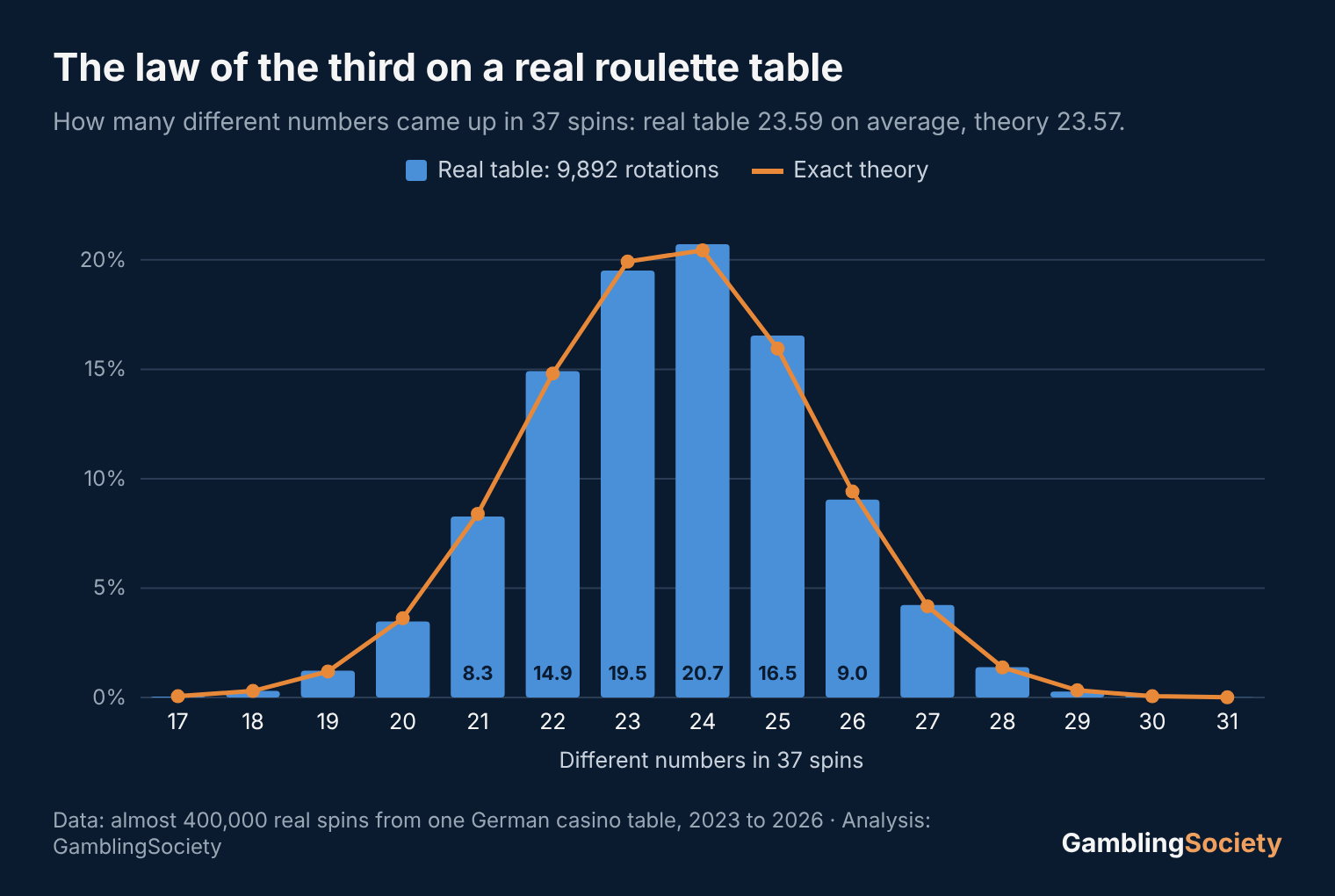
The real table follows the theory closely. The average was 23.59 different numbers per rotation (95% range 23.55 to 23.62), the theory says 23.57. The spread matches too: a standard deviation of 1.89 against 1.90.
| Different numbers in 37 spins | Theory | Real table | Real rotations |
|---|---|---|---|
| 19 or fewer | 1.5% | 1.6% | 154 |
| 20 | 3.6% | 3.5% | 343 |
| 21 | 8.4% | 8.3% | 818 |
| 22 | 14.8% | 14.9% | 1,475 |
| 23 | 19.9% | 19.5% | 1,930 |
| 24 | 20.4% | 20.7% | 2,049 |
| 25 | 15.9% | 16.5% | 1,636 |
| 26 | 9.4% | 9.0% | 894 |
| 27 | 4.2% | 4.2% | 418 |
| 28 or more | 1.8% | 1.8% | 175 |
The fewest different numbers in a real rotation were 17 (it happened 4 times), the most were 31 (once). Every single number was missing in 35.1% to 37.1% of the rotations, around the 36.3% of a fair wheel. A standard test of the whole distribution (chi-square, p = 0.75) finds no difference beyond normal chance.
So the law of the third is real. It is plain probability, and a real wheel with real croupiers produces it just as the formula says.
Are the missing numbers due?
Here the myth starts. If only two thirds of the numbers came in the last rotation, the missing third must be “due”, so the story goes, and should come up more often in the next one. Other players believe the opposite and bet on the numbers that just came, because they look “hot”. The real table answers both.
We looked at 8,542 pairs of back-to-back rotations, 316,054 spins. On average 13.4 numbers were missing in the first rotation. In the next 37 spins those numbers hit 114,483 times. A fair wheel would give 114,630. Per spin that is 2.70% (95% range 2.69% to 2.71%) the same as the 2.70% of a fair wheel.
Numbers that came once, twice or three times and more were no different: 2.70%, 2.71% and 2.71% per spin. Even numbers that had been missing for two full rotations (74 spins) hit 2.69% of the time in the next one (7,192 cases, 95% range 2.66% to 2.72%). The wheel does not keep a list. Our test of colour runs and sleepers on the same data came to the same result.
What if you simply bet on all missing numbers for the whole next rotation? On the real table that meant 4,241,310 units staked and a result of −119,922 units, or −2.8% of the stakes. That is the house edge of 2.7% plus a little bad luck.
A system built on the law of the third: Plein Triumph
Plein Triumph is a system that turns the law of the third into a betting plan. It works with groups of numbers spread around the wheel instead of single numbers:
- The wheel is split into nine groups: eight groups of four numbers and one group of five with the zero. The numbers of a group sit about a quarter of the wheel apart.
- You watch the wheel and note which groups have been hit. When exactly three groups are still missing, these three are your betting groups (12 or 13 numbers).
- You wait until one of the three groups is hit once without a bet (a “virtual hit”). Then you bet 1 unit on each of the 12 or 13 numbers for up to three spins. A hit ends the attack.
- After three misses you wait for the next virtual hit and attack once more, again for up to three spins. After a win or after the second attack you start watching from scratch.
| Group | Numbers | Count |
|---|---|---|
| 1 | 26 · 9 · 23 · 17 | 4 |
| 2 | 3 · 31 · 8 · 25 | 4 |
| 3 | 35 · 14 · 30 · 2 | 4 |
| 4 | 12 · 20 · 11 · 21 | 4 |
| 5 | 28 · 1 · 36 · 4 | 4 |
| 6 | 7 · 33 · 13 · 19 | 4 |
| 7 | 29 · 16 · 27 · 15 | 4 |
| 8 | 18 · 24 · 6 · 32 | 4 |
| 9 | 22 · 5 · 10 · 34 · 0 | 5 |
The idea: three groups have been missing while the others came, so they are “behind”, and the virtual hit is supposed to show that they are waking up. A won attack pays 36 units for the winning number, so with 12 numbers the profit is 24 units on the first spin, 12 on the second and 0 on the third. A lost attack costs 36 units (39 with 13 numbers).
We played it by these rules on all 1,351 casino days. The system made 31,725 attacks with 66,809 bets and staked 818,368 units in total, about 606 units per day.
- 70.1% of the attacks were won. With 12 or 13 numbers for up to three spins, a fair wheel gives 70.1%.
- The final result: −17,188 units, or −2.1% of everything staked (95% range −3.2% to −1.1%).
- With exactly the house edge of 2.7% the loss would have been −22,118 units. The real table was a little kinder than average, well inside the normal range of luck.
- 642 casino days ended ahead, 704 behind and 5 even. The best day brought +349 units, the worst −437.
| Year | Staked (units) | Result (units) | Result per unit staked |
|---|---|---|---|
| 2023 | 163,471 | −2,695 | −1.6% |
| 2024 | 183,839 | −671 | −0.4% |
| 2025 | 229,698 | −4,158 | −1.8% |
| 2026 (Jan to Sep) | 241,360 | −9,664 | −4.0% |
| All | 818,368 | −17,188 | −2.1% |
The chart shows why systems like this feel convincing for a while. In the first months the system was ahead (best point +782 units in April 2023), and 2024 was close to even. Over the full period the line follows the house edge. Plein Triumph wins about seven attacks out of ten. The won attacks bring in many small amounts, the lost ones take bigger amounts, and over time the difference is the house edge of 2.7%.
What the law of the third means at the table
- Expect gaps. In any 37 spins, around 13 numbers will not come up. If your favourite number is among them, that is normal for a fair wheel.
- Missing numbers are not due. A number that has not come for 37 or 74 spins has the same 1 in 37 chance as every other number on the next spin.
- Systems change the ride, not the price. Plein Triumph won seven attacks out of ten and still lost money over time, in line with the 2.7% house edge. Every system on our roulette systems page pays that same price.
- Use the law for your budget. Betting 12 or 13 numbers for a few spins means many small wins and some bigger losses. Decide before you start how much the evening may cost, and stop when that amount is gone or when you are happy with your win.
- Play for fun. Watching how the numbers spread over a rotation is part of what makes roulette entertaining. Our free roulette game lets you try it without money.
What this analysis does not show
- The data comes from one table in one casino. The match with the theory suggests a fair wheel, but it does not prove that every wheel everywhere is fair.
- A rotation is a fixed block of 37 spins. Players who start counting at any other point see the same picture, because the start point does not change the probabilities.
- We tested one version of Plein Triumph with flat stakes of 1 unit per number. Versions with stake increases change how big the swings are, not the 2.7% house edge on every unit staked.
- The leftover spins at the end of each day are not part of the rotation analysis; the Plein Triumph test uses every spin.
FAQ: the law of the third in roulette
What is the law of the third in roulette?
It says that in 37 spins of a single-zero wheel only about two thirds of the numbers come up. The exact average is 23.57 different numbers, and 13.43 stay missing. On a real table we measured 23.59.
Is the law of the third true?
Yes. It follows from basic probability, and 9,892 real rotations from a German casino table match the theory closely: 89.0% of them had between 21 and 26 different numbers, against 88.9% in theory.
Do the missing numbers come up more often afterwards?
No. On the real table, numbers that were missing in one rotation hit 2.70% of the time per spin in the next rotation, the same as the 2.70% of any number.
Can you win with a system based on the law of the third?
Not in the long run. Plein Triumph, which bets on the missing groups, lost 2.1% of its stakes over 1,351 real casino days, inside the normal range around the house edge of 2.7%. Like any system it can be ahead for a while.
How many spins until every number has come up?
On average 155 spins on a single-zero wheel. Half of the numbers (18) take about 24 spins, the last few take the longest.
Related guides
- Roulette Systems Tested: ten systems in more than 100 million sessions, with a simulator and the real-spin test.
- Tiers du Cylindre (Serie 5/8) with Doubling: a wheel-sector system played for months, with real numbers.
- Martingale System: the classic doubling system and how often it really wins.
- How to Play Roulette: rules, bets, payouts and our free roulette game.